

No app
It opens, it does not install
One QR, the destination, the route. No download, no account, no permission to grant before starting.
QR Map is the hospital wayfinding solution developed by Apice Sistemi for complex healthcare facilities. Using geolocated QR codes, patients and visitors can easily find their way to wards, clinics, booking centres, radiology and healthcare services, reducing stress and search time.
Designed for patients, companions and staff: clear, accessible, mobile-first.
An app asks people to find it in the store, install it, create an account and grant permissions. In a hospital, with someone already anxious and a phone in hand, that is exactly where the user is lost. A QR code is framed and the page opens: this is the difference between a system that gets adopted and one that stays half-deployed — and why QR Map is our simplest and most adopted solution.
One QR, the destination, the route. No download, no account, no permission to grant before starting.
Directions follow the language the person selects: Italian, English and the languages of the organisation, with no route to rewrite for each one.
Directions are read out loud without a connection: useful for people who do not look at the screen while walking, and for those with low vision.
A "low friction" approach: it minimises technology barriers and maximises clarity on the ground.
QR codes placed in key areas (entrances, main corridors, floors, junctions). Each QR uniquely identifies its location.
Users quickly select where they need to go: wards, clinics, services. Synonyms and "human-friendly" names can be managed.
Step-by-step directions: "go straight / turn left / take the lift / floor 2". Ideal for reducing stress and disorientation.
We can integrate ward/clinic directories, information pages, opening hours, bookings and communications (notifications, informational QR codes, triage flows).
Indoor navigation implemented to guide people along hospital routes, reducing confusion and search time.
Making wayfinding more intuitive in a high-traffic environment, with clear directions starting from QR codes placed around the facility.
Fewer information requests, fewer delays and a better experience for patients and companions (especially on first visits).
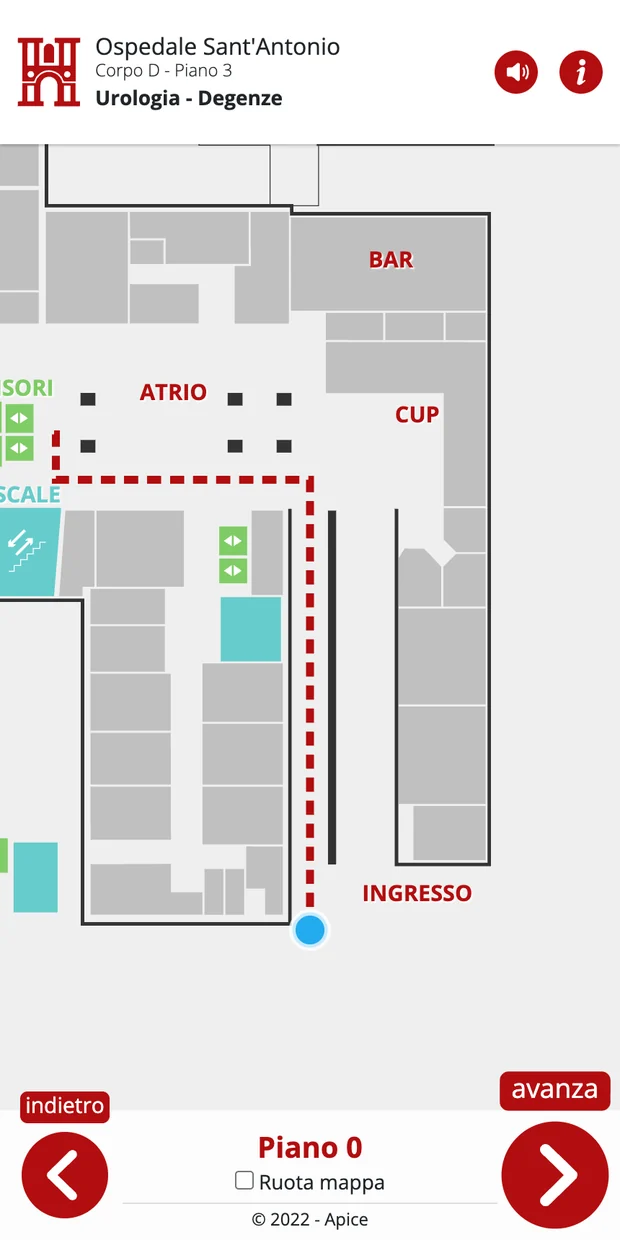
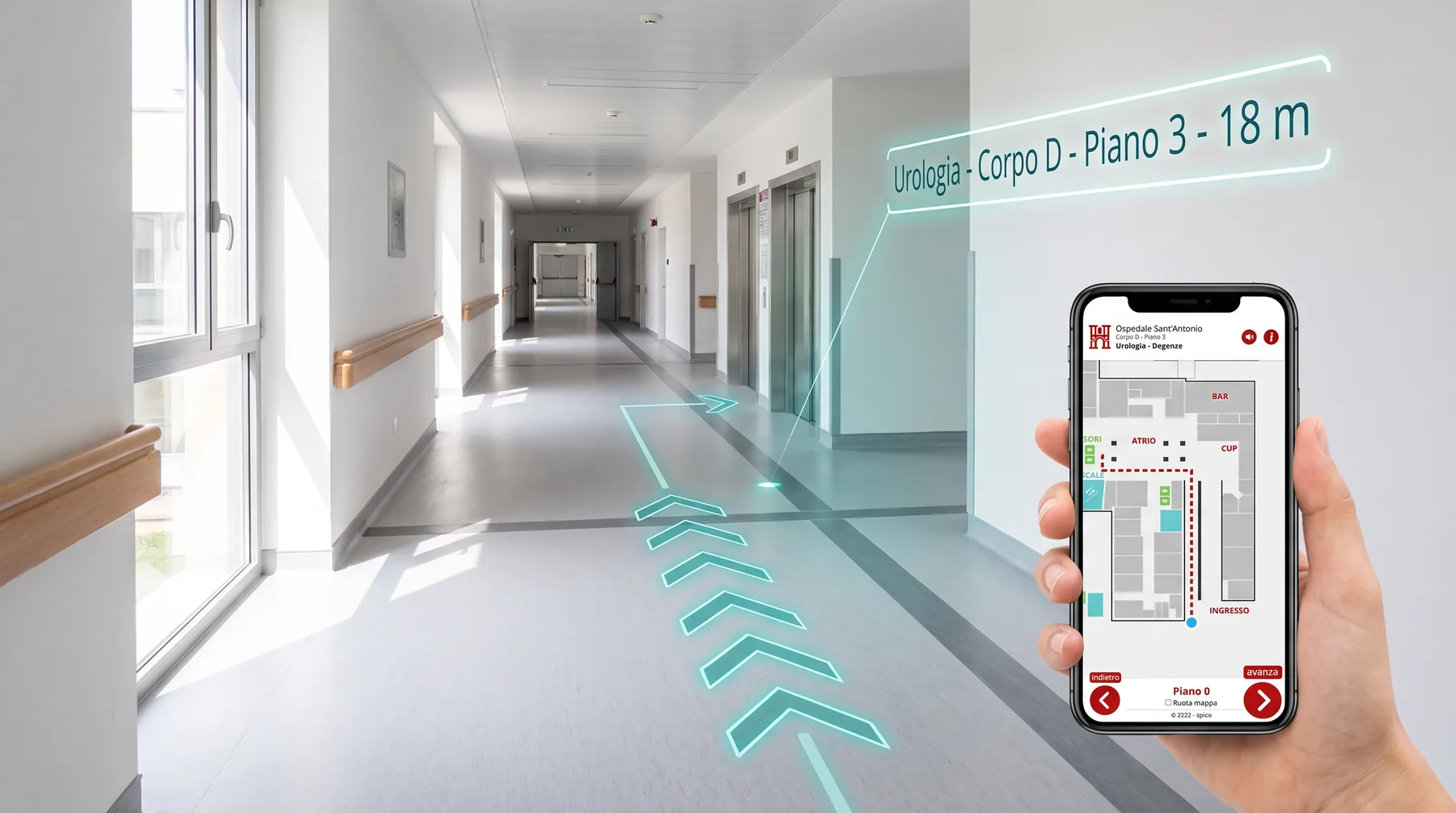
Our proprietary algorithm reads the phone’s spatial data — motion, heading, orientation — and rebuilds your position in real time: waypoint after waypoint it guides you like someone who knows the hospital, correcting directions as you walk. No app to install, no camera to hold up.
| Feature | QR Map Recommended | BLE beacons | AR / XR |
|---|---|---|---|
| App to download | No | Yes, dedicated | Yes, dedicated |
| Camera held up for the whole route | No | Not needed | Yes |
| Works without internet | Yes | Partly | No |
| Works on any phone | Yes | Supported models only | Recent models only |
| Privacy in sensitive areas | No images collected | No personal data | Camera always on |
| Accuracy | Good, at floor level | Good, if beacons work | High, only where mapped |
| Hardware on site | Printed QR only, nothing to power | Beacons to install and power | Dedicated 3D survey |
| Basements, lifts, outdoor areas | Works there too, no network | Only where beacons are | Only where mapped |
| Departments that change or move | Route updated within hours | Beacons to move, map to redo | 3D survey to redo |
| How many devices to install | A few printed QR codes at the main entrances and a few junctions, reprogrammable without hassle | Many: one every few metres, up to hundreds per floor, with batteries and maintenance | No physical devices, but a 3D survey of every floor — to redo whenever something changes |
| Downloads, permissions and confirmations | Nothing: it opens from the QR | App store, account and updates | Dedicated mini-app, camera permissions, 3D model to download |
In short: scan, choose your destination, walk. No devices to power, no app to install, no images of the environment collected.
Wings, long corridors, lifts, outdoor areas, basements where no signal reaches. With QR Map the route already lives on the phone: no network to look for, no hardware to power, no app to install. That is how the system holds up against the real complexity of a healthcare building, without asking anyone to download an app or grant camera access and
And when departments change or move — which happens all the time in a hospital — the route is updated within hours, with no works and no new devices. It reduces the risk of failing exactly when it is needed — and the frustration of a patient who is already having a hard day.
Fill in the form and we will get back to you shortly.